Question:
What sense do you get of what life was like in Elizabethan England?
Life in Elizabethan England:
- The Elizabethan era was between 1558-1603
- During the era was the reign of Queen Elizabeth I
- This period in time of England was dominated by the rich and powerful
- If you were as to go back to the Elizabethan times you wouldn't necessarily find yourself living in a rich man's house or a castle, it would be more likely for you to find yourself upon the heaths and hills.
- 1/4 of England at that time had many hills, heaths and wasteland.
- Right now in the 20th-century horthfields are viewed as peaceful, quiet and scenic, yet Elizabethan people would see them as horrific and dangerous places.
- Around the countryside, you would find many cottages which most likely is where a poor family would live.
- If people of this current time period were to live in cottages, they would find that they are very dark, there is lack of colour, they would sleep and wake up in darkness
- This is because in Elizabethan times candles were expensive and the poor families cannot afford lots of light
- Inside the cottage is very basic: One room, Earth floor, Thick smoke filling the whole room
-The possessions of families who live in cottages are; some ladles, a few pots, a basket and a bench.
- If we were to live in this cottages we would find ourselves sleeping on the floor or on a thin straw mattress; we would also find ourselves being more alert and aware of our surroundings so for example; the crackling of the fire, the child in the cradle, the raindrops on the roof.
- Living in poverty in Elizabethan England is a struggle to survive.
Class in Elizabethan England:
- The Elizabethan society is strictly divided according to the class you inherit( what you are born into)
- Most Countrymen fall into 3 categories;
YEOMAN- owns and rents his farm and employs workers
HUSBANDMAN- rents the land that he works on
LABOURERS- work on other people's farm
- In Elizabethan times as a poor person, the options for looking for work are extremely limited therefore the best bet is to offer yourself as a labourer going from farm to farm. You may also find a yeoman or a husbandman that may allow you to sleep in a barn.
- After a hard day of work as a labourer, there is not much reward but you are given 'a goat' a day which is part of the English currency since medieval times.-- also referenced to as 'fourpence(4d)'
4d= £100
3d= £75
- The amount of money Labourers earn is not enough for them to be able to raise a family unless you grow fruit and vegetables in your garden and make your own clothes.
-Social classes in Elizabethan England: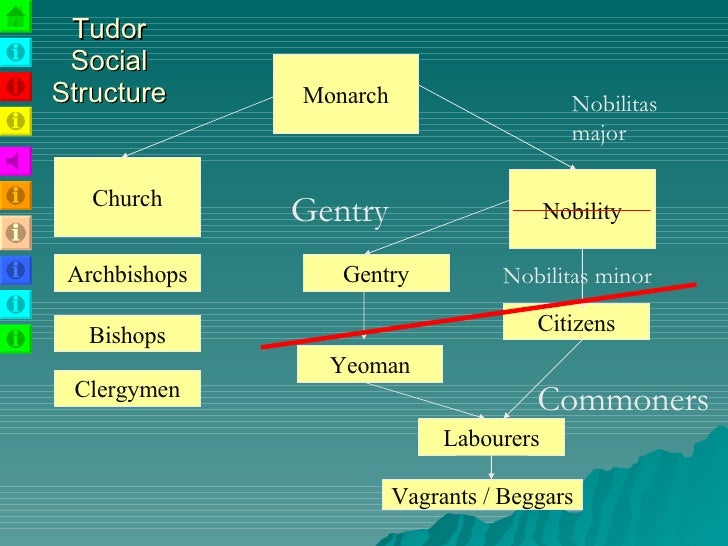
Moncarch= King, queen, anyone else in the royal family, they make important decisions for the country, the most powerful of the classes.
Nobles= Most nobles are born into a noble family or have been enabled by the crown, they inherit incomes and extensive lands, if they were tried for offence they could only be tried by other nobles.
Gentry= knights, squires, gentlemen, gentlewomen, they can only become part of this class if their wealth was obtained or approved of the monarchy.
Merchants= Made their wealth through trades, sells of wools and exotic goods. They could have the wealth of higher classes they did not have the same social status despite how important they were in that time.
Yoemanry= Attendance for nobility and the monarch, they make just enough money to support their families however they could become peasants if they went into debt.
Labourers/Peasants= slaves,shoemakers, do not own land, did not have enough money to support their families, a labourer/peasant can become gentry if they gather enough wealth and they are accepted.
- In terms of linking marriage and class, it was possible in Elizabethan England to marry someone in another class but it was generally looked down upon for one to marry someone in the lower class and therefore rarely occurred.
The population in Elizabethan England:
- The time when Elizabeth I became queen(1533-1603) the population was 2 million people in England
- However during her reign of being queen,the population rose up to about 4.1 million people.
Entertainment in Elizabethan England:
- Feasts- A large elaborately prepared meal, usually for many persons and often accompanied by court entertainment
- Banquets - A ceremonial dinner honoring a particular guest
- Fairs - The Annual Summer Fair was often a bawdy affair
- Plays - Starting as plays enacted in town squares followed by the actors using the courtyards of taverns or inns ( referred to as Inn-yards ) followed by the first theatres ( great open air amphitheatres built in the same style as the Roman Coliseum ) and then the introduction of indoor theatres called Playhouses
- Mystery Plays - Re-enacting stories from the Bible
- Festivals - Celebrating Church festivals
- Dancing - Elizabethan dances enjoyed by the Upper Classes, Royalty and Nobility included the Cinque-pace, Galliard, Pavane, Roundel, Tordion and the Volta
- Jousts / Tournaments - A series of tilting matches between knights
- Games and Sports - Sports and games which included archery, bowling, cards, dice, hammer-throwing, quarter-staff contests, quoits, skittles and wrestling
- Animal Sports - Including Bear and Bull baiting. Dog and Cock fighting
- Hunting - Sport followed by the nobility often using dogs
- Hawking - Sport followed by the nobility with hawks
The Names and Types of Elizabethan Entertainment were as follows:
- Jesters - A fool or buffoon at Elizabethan courts
- Mummers - A masked or costumed merrymaker or dancer especially at a festival
- Minstrels - Travelling musician who sang of legends (declined in the Elizabethan era)
- Troubadours - Travelling musician who sang of courtly love (declined in the Elizabethan era)
- Acting Troupes - Travelling actors
- Jugglers - Also used tricks, deception, or fraud
Reference:
http://www.elizabethan-era.org.uk/elizabethan-entertainment.htm
From all this information I can evaluate that:
- As there was no technology back then, entertainment was provided by things like sports, plays and festivals
- Yet the entertainment provided wasn't just for anybody, the noble and upper classes got to enjoy any type of entertainment because of the authority and wealth they had
- Peasants wouldn't get the most of the entertainment because most of the time they couldn't afford
it, but if they could it would be sure that they would get the worst of the entertainment i.e in plays peasants had to sit on the floor.
- Life wasn't the best in the Elizabethan era but they had amazing entertainment which Elizabethan people loved and the entertainment was very popular when there was something to celebrate
Religion in Elizabethan England:
PROTESTANT VS CATHOLIC...
- The two main religions of the Elizabethan era were Catholic and Protestant
- In the early 1500's all the people of England practiced the Roman Catholic religion
- However, the practices of this religion were questioned leading to the reformation; therefore a new religion called Protestantism was introduced under the beliefs of German Martin Luther(1483-1546)
- There were many convictions and beliefs between both religions and this led to executions of many of the followers of these Elizabethan religions.
- Within more or less the past decade, the nation had gone from Protestant under Edward VI to Catholic under Mary and now back to Protestant.
- Now there was the threat of religious disruption and violent persecution alongside the plague, inflation and the war with France and Scotland.
- Queen Mary who was the former queen before Queen Elizabeth, was very passionate about the Catholic religion so if anyone followed the protestant religion she would have them burnt alive.
CATHOLICS:
- Believed there was a direct link between the pope and God
- Priests expected to devote their lives to God; by remaining unmarried and wearing elaborate robes
PROTESTANTS:
-Believed people could find God without a priest or a pope.
- Ministers were ordinary people who led normal lives
- They would wear ordinary robes
SIN:
- In Catholicism:
Believed that priests and popes could forgive sin
However, this came at a price
Gifts and indulgences were to be given
- In Protestantism:
Believed that ONLY God could forgive your sins
The sins in religion in Elizabethan England:
- Pride because it interferes with the individual recognition of the grace of God
- Envy is a desire for others traits, abilities, status or situation which is a sin because you should happy and grateful for how God made you
- Gluttony is an inordinate desire to consume more than which one requires which is also a sin because as a believer you should be happy with what you have and understand that God knows best and we shouldn't lean on our own understanding
- Lust is an inordinate craving for the pleasures of the body ad is a sin because in the Bible it says that our body is our "temple" therefore we should keep it holy.
- Anger is manifested in the individual who spurns love and opts instead for fury. This can be considered a sin because God wants us to be able to control our anger so it doesn't lead to something else worse, that could essentially get us into big trouble.
- Greed is the desire for materialistic things and wealth or gain which is ignoring the realm of the spiritual. It is viewed as a sin because it is as though you are wanting earthly things more than the one who made you, God. You are more engaged in the activities of the world when you should just be in the world and focus on God.
Sloth is the avoidance of physical or spiritual work and is considered a sin because it is like ignoring God.
Superstitions in Elizabethan England:
- First of all the definition of superstition is "excessively credulous belief in and reverence for the supernatural."
- The belief in superstitions and supernaturals were common practices
- Superstitions were based on fear of the unknown and unexplainable natural occurrences.
- I.e: Sneezing opened your soul to the devil and evil spirits, eclipses were an omen of evil and death, witches commonly performed seances to summon spirits
- Elizabethans believed that fairies and goblets came out at night to play tricks on people
- They believed that these devilish creatures could make people go insane and give them nightmares
- Women who didn't fit into the society were branded as witches and accused of working for the devil
- It was considered unlucky for black cats to cross your path ever because they were associated with witches
- Strongly believed also that it was unlucky to walk under ladders because they were strongly associated with executions.
- The eye of the feathers of a peacock were viewed to be the eyes of the devil or the eye of evil
 In Elizabethan times, there is a different way of looking at life compared to nowadays. They believed in a divine order or great 'chain of being'. The divine order was a belief that everything in the universe has a specific place and rank in order of spiritual nature. The more spirit or person or object a person had, the more power they possessed. In Elizabethan times, there is a different way of looking at life compared to nowadays. They believed in a divine order or great 'chain of being'. The divine order was a belief that everything in the universe has a specific place and rank in order of spiritual nature. The more spirit or person or object a person had, the more power they possessed.
- Different 'humors':
Blood
Yellow Bile
Black Bile
Phlegm
It was thought that if these 4 humors weren't balanced when a person was healthy it would not only affect their physical health but also their personality.
There was also Bloody Mary: You stand in front of a mirror and stand alone, you turn off all the lights and say the simple phrase "Bloody Mary Bloody Mary Bloody Mary" Then you stare at the mirror and it is said that she will appear to you and come through the mirror and kill you.
Money in Elizabethan England:
- During the reign of Queen Elizabeth I all currency was in the form of coins
- The coins were either made out of gold or silver and the weight of it determined the value of the coin
- The Elizabethan monetary system was comprised of penny, shilling, and the pound
- The abbreviation of a penny is "d" after the silver Roman coin, Denarius.
- The abbreviation of shilling is "s" after Sestertius, also a silver Roman coin.
- The pound was known as "L" with a crossed bar to look like "£". This was an an abbreviation for the latin word for pound, Libra
UNITS AND VALUES OF ELIZABETHAN CURRENCY:
http://www.elizabethan-era.org.uk/elizabethan-period-money-and-currency.htm
- In Elizabethan time, wages depended on your job status so for instance, the lower class earned their wage in pennies whilst the upper class earned theirs in pounds annually. It is almost the same as today as your wages do depend on the type of job you have.
- For example, a typical nobleman earned 1,500 to 3,000 pounds per year whereas a carpenter only earned approximately 13 pounds per year.
- Currently, our currency uses paper bills and coins. Yet our coins do not have nearly as much silver and gold as Elizabethan coins did
- Because of this, it meant that Elizabethan money bought more back then than our currency does today.
- Money played a part of the struggle of the Elizabethan era because life in Elizabethan times was not very cheap. This is why it was a hard time for people living in poverty.
- The many necessities required in everyday life were clothing and fabric, food and drink,fines,housing and indulgences.
- For example, Boots could cost four to ten pounds, cinnamon cost about 10s 6d= 10 shillings and six pennies(per pound), and a doctors visit cost one mark( 13s 4d)= 13 shillings, 4 pennies
Jobs in Elizabethan England:
- Jobs were based on class and social ranking
- The nobles were quite high up in the social ranking, therefore they rarely had jobs, they just had to make sure the servants were doing their job correctly and everything was running smoothly.
- The Gentry lived like they were nobles though they couldn't become nobles. They were educated and they were advisors of the Queen.
- Knights would fight and serve the queen.
- Yeoman were hard workers, they were not rich though they were comfortable.
- Peasants were the poorest of the poor and they worked the jobs that nobody wanted for very little play.
- Many people were unemployed in Elizabethan England
- It was very difficult at the time to find work in towns, cities and the countryside
- Jobs were limited and a lot of people were in desperate need of work
- Some of the popular jobs in Elizabethan era
Bottler who stored and dispensed wines
Chaplain who is responsible for religion activities of castle servants
Apothecary gave remedies made from herbs, plants, and roots
Cordwainer a shoemaker or the Cobbler, craftsman who made shoes
Spinster which was an occupation gave to a woman who earned her living spinning yarn.
-Popular jobs today
Doctor
Nurse
Welder
Marine biologist
Veterinarian
- Jobs today still determine people's income and wealth
- Today English people take pride in their history and they respect the customs and traditions of England
-Around 95% of English people live in urban areas nowadays meaning that places are crowded with shoppers, office workers and people going to see entertainment like theaters and restaurants.
Medicine in Elizabethan England:
- The Elizabethan times were dark times for any form of medicine back then
- There were diseases such as malaria, small pox and the Bubonic Plague
- The Elizabethans were not educated enough in medicine
- The practices for any form of medicine did more harm than good
- Medicine was basic and practices to treat disease were based on superstition and also the teaching of Aristotle.
- Doctors had to be well educated and had gone to physician universities like Cambridge or Oxford
- You needed to have a certain amount of money to receive treatment, therefore only the wealthy received treatment
- Doctors wore bird-like masks to protect themselves from the plague whilst trying to treat patients
Elizabethan medicines were basic, to say the least. Letting blood was conducted by cupping or leeches. The Medicine used to treat various illnesses were as follows:
- Bubonic Plague ( the Black Death )= Bubonic Plague was treated by lancing the buboes and applying a warm poultice of butter, onion and garlic. Various other remedies were tried including tobacco, arsenic, lily root and dried toad.
- Head Pains= Head Pains were treated with sweet-smelling herbs such as rose, lavender, sage, and bay.
- Stomach Pains and Sickness= Stomach pains and sickness were treated with wormwood, mint, and balm.
- Lung Problems= Lung problems given the medical treatment of liquorice and comfrey.
- Wounds= Vinegar was widely used as a cleansing agent as it was believed that it would kill disease.
The underlying cause of many of the Elizabethan illnesses was the lack of sanitation, especially in large towns or cities such as London. There were open sewers in the streets which were also filled with garbage. This was occasionally removed and waste was dumped into the nearest river such as the Thames. Diseases were easily spread in this unsanitary environment where fleas, lice and rats all flourished. There was no running water, this was obtained from water pumps ( a main cause of the spread of typhoid ).
http://www.elizabethan-era.org.uk/elizabethan-medicine-and-illnesses.htm
From all this information I can understand that England back then was extremely unhygienic and unsanitary which made a home for rats to come about. So, therefore rats were carrying a nasty flee called "Yersinia pestis" which essentially caused the bubonic plague in London to spread. The rat comes into contact with the human and the flee ten attaches itself to the human, infecting their blood etc. It is also shown from the information that doctors tried to treat these diseases with natural things like herbs and mint.
Theatre in Elizabethan England:
- Elizabethan Theatre is usually associated with the famous playwright Wiliam Shakespeare who produced his plays in the time of Queen Elizabeth's reign. He plays were first performed during 1589-1613
- Along with Shakespeare, Christopher Marlowe and Ben Johnson were also well-known writers in the Elizabethan times
- Elizabethan people loved theatre and plays and theatres were as popular as movies and cinemas of the early 20th century.
- Theatres are still popular today and most visitors to London at least visit one of the theatres.
- London authorities refused to allow plays to be performed within the city, so theatres opened across the Thames in Southwark
- Plays were performed in the courtyard of inns or sometimes the houses of noblemen
- Theatre performances were held in the afternoon because there was no artificial lighting to use.
- No women performed in plays so female roles were generally played by young boys
- Women, however, attended plays but a prosperous woman would wear a mask to hide her identity.
- The Globe was the most famous theatre in Elizabethan era
- Although the theatres had slight differences they shared great similarities and one of them is that fact that they were all built with a circular footprint like a giant letter 'O'
- They were all also almost entirely open to the open air. The plays were produced during the months May-October.
- Companies blew a flag above the theatre to indicate that there was a performance that day
- The audience sat around in three levels
- The higher the level, the more expensive the seat and this was partly because the closer one was to the roof, the better coverage on rainy days. Also because it gave you elevation to see what was happening on stage whereas the audience who stand in the yard or the area in front of the stage for the price of a single penny( they were known as the "penny-stinkers" and then later on the "groundlings"
- The audience sometimes threw things at characters they didn't like.
To conclude, the sense I get from what life was like in Elizabethan England is that is was a huge struggle living in that time in terms of jobs,class and money however it seems like one of the most fascinating periods in the History of England because a lot happened that still happens now and it is interesting to know that some of the things that we still have in England or still do now, started off in Elizabethan England. I feel that because they had a lot of fun events going on like entertainment, music, plays, language, medicine etc and it really does make Elizabethan England come across as a joyous and intriguing era to live in.
|


 This version of Hamlet is also very cinematic with it's defined actions, implementing set and costume usage to give us a feel on the time and mood in convincing fashion. Doran's piece finds a balance between Shakespeare's presence in the play and the use of film-like stage and atmosphere that makes Hamlet feel current, unforgettable and reflective.


